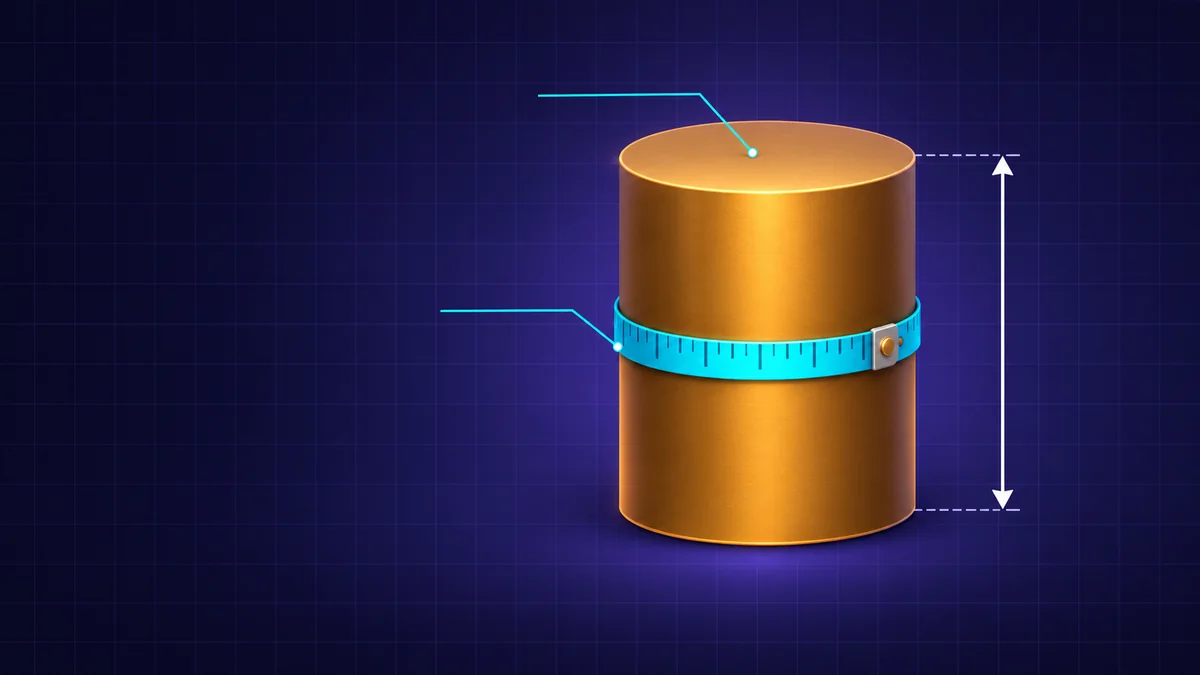
Circumference is often the easiest reliable measurement when the centre of a circular end is hidden. A flexible tape can wrap around a tank, column, drum or pipe even when calipers cannot span its diameter. The formula below converts that around-the-object measurement directly into volume.
The method assumes a circular cross-section and a constant diameter along the measured height. Tapered, oval, dented or irregular objects need several readings or a model that better represents their shape.
When is circumference the best measurement?
Use circumference when you can reach the curved wall but cannot confidently locate the centre or measure straight across the circular face. It is especially practical for installed columns, closed drums, upright tanks and large pipes.
- The tape can pass completely around the object.
- The cross-section is circular rather than elliptical.
- The tape can stay level, in a plane perpendicular to the cylinder axis.
- You also know the perpendicular height or length of the cylinder.
If you already have a reliable diameter, the diameter calculator is the shorter route. If the shape tapers, take circumference readings at several positions and treat the result as an estimate rather than exact capacity.
The direct formula and its variables
| Symbol | Meaning | Unit rule |
|---|---|---|
| V | Volume enclosed by the ideal cylinder | Cubic units, such as cm³ or m³ |
| C | Circumference around the circular cross-section | A length unit |
| h | Perpendicular height, or axial length for a horizontal cylinder | The same length unit as C |
| π | The circle constant pi | Dimensionless; the calculator uses Math.PI |
Why does V = C²h ÷ 4π?
Start with the usual volume formula, V = πr²h. Circumference is C = 2πr, so the radius is r = C/(2π). Substitute that expression for r:
- V = πr²h
- V = π[C/(2π)]²h
- V = πC²h/(4π²)
- Cancel one π to obtain V = C²h/(4π).
Worked example: a cylindrical column
A circular column has a circumference of 2.00 m and a perpendicular height of 3.00 m. Calculate its ideal geometric volume.
- Square the circumference: C² = 2.00² = 4.00 m².
- Multiply by height: C²h = 4.00 × 3.00 = 12.00 m³.
- Divide by 4π: V = 12.00/(4π) = 0.95493 m³.
- Convert if useful: 0.95493 m³ = 954.93 L.
A radius check reaches the same result: r = 2/(2π) ≈ 0.31831 m, then π × 0.31831² × 3 ≈ 0.95493 m³. The direct formula is preferable when you want to avoid rounding the radius before the final step.
Worked example: outside size versus inside capacity
Suppose a closed drum has an outside circumference of 1.885 m, an internal height of 0.900 m, and a uniform wall thickness of 5 mm. The outside circumference implies an outside radius close to 0.300 m, but that outside radius does not describe the liquid space.
Outside radius: rout = 1.885/(2π) ≈ 0.300 m
Inside radius: rin ≈ 0.300 − 0.005 = 0.295 m
Estimated internal capacity: V = π × 0.295² × 0.900 ≈ 0.246 m³ ≈ 246 L
Using the outside circumference directly would give roughly 254 L, an overstatement of about 8 L. Real containers may also have curved ends, seams, fittings or a stated nominal capacity, so use manufacturer data for consequential decisions.
How to measure circumference accurately
Wrap a flexible tape around the cylinder in a plane perpendicular to its axis. Keep the tape level, remove slack without stretching it, and avoid raised seams or fittings. Take more than one reading if the surface is rough or the diameter appears to change.
- Keep the tape level. Check the wrap from more than one side.
- Use gentle, consistent tension. Remove slack without compressing soft material.
- Measure the intended boundary. Outside circumference gives outside geometry; capacity needs the inside boundary.
- Repeat on imperfect objects. Variation between positions reveals taper, ovality or dents.
- Record the unit and resolution. A value written as “188.5” is unusable unless its unit is known.
Units, conversions and sensible precision
C and h must use compatible length units before the formula is applied. If both are in centimetres, the result is in cubic centimetres. If both are in metres, the result is in cubic metres. Convert the final volume afterward when possible.
- 1,000 cm³ = 1 L
- 1 m³ = 1,000 L
- US liquid gallons and imperial gallons are different units; select the intended system explicitly.
These metric volume relationships follow the SI convention summarized by NIST’s volume-unit guidance. The circumference calculator converts each input to a common internal unit, uses Math.PI at full JavaScript floating-point precision, and rounds only the displayed result.
Measurement quality still limits the useful digits. Because C is squared, a small relative error in circumference has roughly twice that relative effect on volume. Height error contributes approximately one-for-one.
Common mistakes to avoid
- Using C as if it were a diameter. Diameter is C/π, not C.
- Mixing centimetres and metres. Convert first or use a calculator that tracks units independently.
- Measuring a spiral. A slanted tape creates a path longer than the true circumference.
- Using outside girth for liquid capacity. Wall thickness, lining and insulation reduce the interior radius.
- Rounding the recovered radius too early. Use V = C²h/(4π) directly or keep guard digits.
- Treating a tapered object as perfectly cylindrical. State that the result is an estimate and take several readings.
Practice questions with checked answers
1. A can has C = 31.416 cm and h = 10 cm. What is its volume?
V = 31.416² × 10/(4π) ≈ 785.4 cm³, or about 0.785 L.
2. A column has C = 1.20 m and h = 2.50 m. What is its volume?
V = 1.20² × 2.50/(4π) ≈ 0.2865 m³, or about 286.5 L.
3. A round tube has C = 94.248 cm and length 2.00 m. What outside volume does that describe?
First use one length unit: C = 0.94248 m. Then V = 0.94248² × 2/(4π) ≈ 0.1414 m³. This is outside geometric volume, not necessarily internal capacity.
Frequently asked questions
Can circumference alone determine cylinder volume?
No. Circumference determines the circular base area, but volume also needs the cylinder’s perpendicular height or axial length.
How do I convert circumference to diameter?
Use d = C/π. To convert circumference to radius, use r = C/(2π).
Is girth the same as circumference?
In this context, yes. “Girth” is the distance measured around the object, which is its circumference at that position.
Should I measure inside or outside circumference?
Use the boundary that matches the quantity you need. Outside circumference describes the external cylinder. Internal capacity requires an inside circumference or a reliable correction for wall and lining thickness.
What happens if the circumference measurement is 2% high?
With height unchanged, the volume will be about 4% high because the formula contains C². More exactly, 1.02² = 1.0404, so the calculated volume is 4.04% high.